
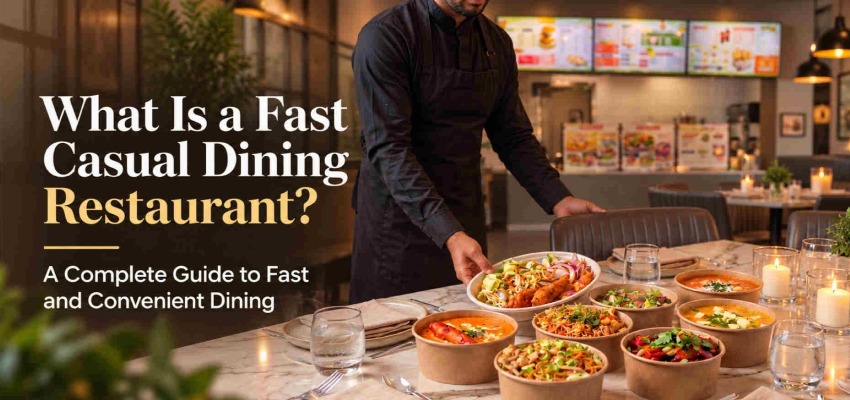
Counter service used to mean one thing: fast, cheap, and forgettable. A different model built on top of that same counter, one where the food is made fresh per order and the price reflects it, has become one of the fastest-growing parts of the restaurant industry.
This guide explains what sets that category apart from quick service and casual dining, which cuisines are driving its current growth, and what opening one looks like from a business standpoint for someone evaluating a franchise.
Quick Summary: A fast casual dining restaurant combines made-to-order food with counter-service speed, priced above quick service but below casual dining. The global market is projected to grow from $203.6 billion in 2026 to $339.5 billion by 2034, per Straits Research. Indian cuisine is part of that growth, with a 6.1% projected CAGR through 2032, per Persistence Market Research.
What Is a Fast Casual Dining Restaurant?
A fast casual dining restaurant sits between quick service and casual dining on both price and format. Customers order and pay at a counter, like quick service, but the food is prepared fresh per order instead of assembled from a holding line or heat lamp.
There's no table service, but there's also no drive-through speed pressure pushing every order out in under a minute. The kitchen is often visible or semi-open, which signals fresh preparation rather than pre-made inventory sitting under a warmer.
The three models compare like this:
| Model | Customer Experience | Best Fit For |
|---|---|---|
| Express/QSR | Order at counter or drive-through, food pre-assembled or held, minimal wait | High-volume, low-price, speed-first markets |
| Fast Casual | Order at counter, food made fresh per order, no table service | Customers wanting quality and speed without a sit-down commitment |
| Fine Dining | Table service, full menu, longer visit | Customers seeking a full dining occasion |
The category traces back to the late 1990s, when a handful of chains began experimenting with counter service built around visibly fresh preparation rather than speed alone, before gaining wider traction in the years that followed. That original bet, that customers would pay a premium for food they could watch being made, still defines the format today.
Digital ordering has changed how customers interact with the counter itself, even where the core format hasn't changed. Kiosks, mobile apps, and delivery integration now sit alongside the traditional line, letting customers customize an order before they ever reach a cashier. That shift has made the format's biggest strength, visible customization, work through more channels than the counter alone.
Indian cuisine has increasingly found a home inside this format rather than staying limited to full-service dining. The Indian segment of the U.S. Asian food market is projected to grow at a 6.1% CAGR through 2032, according to Persistence Market Research, with roughly 4.8 million people of Indian origin living in the U.S. as of 2024.
That combination, a growing cuisine and a service model built for counter operations, is a large part of why regional Indian dishes are showing up on more menus built for speed.
Regional Cuisines and Dishes Driving the Category's Growth
Indian food isn't one flavor profile. Different regions bring different bases, and several have become recognizable menu anchors well suited to counter-service formats, since each translates into a single composed dish rather than a spread that needs table service to manage.
| Region | Core Flavors | Signature Dishes |
|---|---|---|
| North Indian | Tomato and cream-based gravies, garam masala, tandoor cooking | Butter chicken, tikka masala, naan |
| South Indian | Rice-based, curry leaf, mustard seed, tamarind | Dosa, sambar, idli |
| Indo-Chinese | Soy sauce and vinegar layered over Indian spice bases | Gobi Manchurian, Chili Chicken, Hakka noodles |
Biryani
Biryani is a layered rice dish cooked with meat or vegetables and whole spices, traditionally sealed and slow-cooked. It travels well into counter service because it's a single composed order rather than a multi-dish spread, which keeps prep and pickup predictable.
Chaat
Chaat is a category of savory street snacks built around fried dough, chutneys, and yogurt, typically assembled to order. Its small-plate, made-in-front-of-you format maps naturally onto counter-service dining, where customers can watch each component come together.
Indo-Chinese Cuisine
Indo-Chinese cuisine developed in Kolkata in the 19th century, when Chinese migrants combined their cooking techniques with Indian spices and ingredients. Dishes like Gobi Manchurian and Hakka noodles now appear on Indian restaurant menus across the U.S. as a distinct category, not a side note, and they hold up well to the high-volume, made-to-order pace this style of dining requires.
Tikka Masala
Tikka masala is grilled or roasted meat, most often chicken, finished in a tomato and cream-based sauce. It's typically served over rice or with naan, and its single-bowl format makes it one of the easiest North Indian dishes to standardize across multiple locations.
Naan and Tandoor-Cooked Bread
Naan is a leavened flatbread traditionally cooked in a tandoor, a cylindrical clay oven that reaches high, consistent heat. Because it cooks in minutes and pairs with nearly every North Indian dish on a menu, it's become a standard side across counter-service Indian concepts.
From Consumer Demand to Franchise Opportunity
None of this growth is happening in the abstract. A category with rising demand and a format built for counter service is, structurally, a category built for franchising.
The economy favors a franchisee in a clear way. Build-out and staffing needs are lower than full-service casual dining. Yet the average ticket is higher than the quick service. Repeat visits are also stronger than quick service.
A location does not need a full dining room staff or a large back-of-house team to run well. This keeps labor costs and hiring risks lower than a full-service concept. That mix of manageable overhead and steady repeat demand turns a growing cuisine category into a franchise of choice.
It is not just a dining trend you watch from the outside.
When a food trend grows and a service model can scale, a market shift becomes a business choice to consider. The next section breaks down how that decision compares restaurant formats more broadly.
Comparing Restaurant Business Models for Franchise Investment
For someone evaluating where to put capital, the model determines the operating reality as much as the cuisine does.
| Model | Staffing Needs | Capital Intensity | Franchisee Fit |
|---|---|---|---|
| Quick Service | Lean, high turnover | Lower build-out cost | High-volume operators comfortable with thin margins |
| Fast Casual | Moderate, food-prep focused | Mid-range build-out | Owners wanting quality positioning without full-service overhead |
| Casual/Fine Dining | Larger front and back of house | Highest build-out cost | Operators with hospitality experience and higher capital |
A counter-service concept usually needs less build-out budget and fewer staff than full-service restaurants. This is why first-time franchisees often choose it before a larger full-service investment. The tradeoff is a lower average ticket per visit than a full-service restaurant. Higher transaction volume and lower staffing overhead per order offset this.
Tabla's Approach to This Category
Tabla has served Indian, Indo-Chinese, and Thai cuisine since 2008. The brand offers three franchise formats: Fine Dining, Fast Casual, and Express/QSR. Franchisees can choose based on their target market and available capital.
Franchise Fee and Investment Range
The Fast Casual franchise fee is $36,000, with total investment ranging from $187,201 to $405,682. Ongoing costs include a 6% royalty and a 2% brand development fund contribution, both calculated on gross sales.
Chef-Independent Systems
Tabla’s kitchen systems are built to run without a franchisee hiring an executive chef. Prep procedures are standardized across all locations. That matters most in counter service, where consistent results depend on a repeatable process, not one person’s judgment.
Training and Launch Support
Training runs two to three weeks depending on format, covering operations, food preparation, staffing, and service standards, with on-site support during opening week. Fast Casual franchisees receive two weeks of training focused on guest service and day-to-day operational standards.
Site Selection and Marketing Support
Tabla provides site selection guidance by format and local market, along with marketing support for building initial and ongoing customer awareness. Both are part of onboarding rather than something a new franchisee has to arrange separately.
What Comes Next, Depending on Where You're Standing
For a diner, the category’s growth means more regional Indian cuisine. It goes beyond the few dishes that first appeared on American menus. Biryani, chaat, and Indo-Chinese dishes are now easier to find without sitting down. You can also get them faster than before.
For someone evaluating a franchise, the same growth means a category with a service format built for efficient operations. Tabla offers three formats. They help franchisees match the opportunity to their budget and market.
This avoids defaulting to the most familiar format. A fast casual location needs less build-out budget than a full-service restaurant. It still gives customers counter-visible prep that built the category’s reputation.
Frequently Asked Questions Fast Casual Dining Restaurant
Q: What Defines This Style of Restaurant?
It's a counter-service format where food is made fresh per order rather than pre-assembled, sitting between quick service and casual dining on both price and experience.
Q: How Is This Format Different from Fast Food?
It prepares food fresh to order rather than holding it under a heat lamp, which generally means a higher price point and stronger food quality perception than fast food.
Q: How Big Is the Fast Casual Restaurant Market?
The global fast casual restaurant market is projected to grow from $203.6 billion in 2026 to $339.5 billion by 2034, a 6.6% CAGR, according to Straits Research.
Q: Why Is Indian Cuisine Well Suited to This Style of Dining?
Many Indian dishes, including biryani and chaat, are composed single orders or made-to-order snacks that translate naturally into counter service rather than requiring a full table setup.
Q: Is Opening One of These Restaurants a Good Business Opportunity?
This format generally requires lower build-out and staffing costs than full-service casual dining while supporting a higher average ticket than quick service, which is part of why it has attracted steady franchise investment.
Q: What Restaurant Formats Does Tabla Franchise?
Tabla offers three franchise formats: Fine Dining, Fast Casual, and Express/QSR, each with different space and investment requirements.
Q: How Long Has Tabla been in Business?
Tabla has been serving Indian, Indo-Chinese, and Thai cuisine since 2008.
Q: What Support Does Tabla Provide Franchisees?
Tabla provides site selection guidance, marketing support, training running two to three weeks depending on format, and on-site launch support during opening week.
Q: How Do I Start a Franchise with Tabla?
Prospective franchisees can submit an inquiry through Tabla's franchise application form to begin the process, which includes a team consultation, a location visit, and franchise documentation.
Take the Next Step
As fast casual dining continues to evolve, Indian cuisine offers versatile options that can adapt well to the format. For those exploring a restaurant franchise opportunity, Tabla offers Fine Dining, Fast Casual, and Express/QSR formats to consider based on location, investment requirements, and business goals. Visit Tabla Franchise to review the available options and determine which model may be the right fit for your plans.

Vasu Kohli
Vasu is a food and hospitality writer passionate about showcasing Tabla Indian Restaurant's franchise journey and growth. Through insightful content, she highlights what makes Tabla a compelling franchise opportunity, covering its proven business model, scalable operations, authentic culinary systems, and successful expansion across multiple states. She also brings the brand's dining experience to life by sharing stories about Tabla's authentic Indian cuisine, signature dishes, warm hospitality, and memorable guest experiences, helping readers discover what makes every visit special.