A food express franchise used to be judged on how fast a queue cleared at the counter. The features that decide the outcome now sit further back, in the menu, the site and the ordering systems, because most of the demand no longer arrives at the counter.
This guide covers what the format is, the features that determine whether one works, and how they show up in one brand's published Express terms.
Quick Summary
Off-premises took 83% of limited-service customer traffic in 2024, up from 76% in 2019, per Circana/CREST data in the National Restaurant Association's off-premises report. Delivery drove most of that rise, from 4% to 9%. The association also reports that 94% of consumers say speed is critical. Tabla, operating since 2008, franchises an Express format.
Understanding the Express Restaurant Franchise Model
The format is defined by what it removes. There is little or no table service, the menu is shortened to the items that sell, and the unit usually sits inside a site that already carries traffic.
That structure answers where orders now come from. Off-premises accounted for 83% of limited-service customer traffic in 2024, up from 76% in 2019, per Circana/CREST data in the National Restaurant Association's off-premises report.
The channel detail shows which part moved.
| Channel | Share of limited-service traffic, 2019 | Share in 2024 |
| Drive-thru | 41% | 43% |
| Takeout | 31% | 31% |
| Delivery | 4% | 9% |
Source: Circana/CREST, via the National Restaurant Association's off-premises report.
Takeout held flat and drive-thru barely moved. Delivery more than doubled, which is the change that matters most for how a kitchen handles simultaneous orders.
Cuisine matters alongside channel mix. Datassential places Indian cuisine at the Adoption stage of its Menu Adoption Cycle, with Thai at Proliferation, and reports 30% of US consumers love or like Indian food against 42% for Thai.
Key Factors That Make an Express Restaurant Franchise Successful
Six features are worth examining before anything about decor or branding.
1. A Menu Short Enough to Run at Speed
Menu length drives most of the other decisions. Fewer items means fewer prep stations and shorter training, and narrows what can go wrong when several channels fire at once.
Indian food travels in this form. Datassential's Firefly database counts 5,661 Indian restaurants, excluding food trucks and ghost restaurants, and separately counts 2,222 Indian ghost kitchens, against Thai at 7,515 and 355.
2. Throughput Across Several Channels at Once
A counter queue, a mobile pickup order and a courier collection all compete for the same kitchen, and speed has to hold across all three. The National Restaurant Association's off-premises research reports that 94% of consumers say speed is critical, with drive-thru customers at 92%.
Order entry and collection also compete for the same floor space at peak, which is why many operators separate the two.
3. A Site That Already Carries Traffic
An express unit in a mall, food court, terminal or campus building is buying access to existing footfall, so the lease matters alongside the trade area. The question is not whether the format can draw customers to a location, but whether the people already passing through will buy this menu repeatedly.
Trading hours, signage, extraction routes and permitted cooking equipment are typically set by the host site, and each can rule out part of a menu before the first service.
4. Digital Ordering Built In Rather Than Added On
Mobile ordering was used recently by 57% of adults, rising to 74% of millennials and 65% of Gen Z adults, per the National Restaurant Association's off-premises research. Delivery is widely offered in the segment, with 65% of limited-service operators now offering it.
5. Repeat-Visit Mechanics
Loyalty tied to the ordering account is how repeat visits get recorded, and 65% of drive-thru users and more than 60% of takeout and delivery users call loyalty membership an important factor when choosing a restaurant.
6. Consistency a New Operator Can Reproduce
The least visible feature. A short menu run at speed depends on every unit producing the same item the same way, which is a training and standards question rather than an equipment one, and it is why the training system matters more than recruiting experience off the market.
From Consumer Behaviour to Franchise Decision
The six features discussed above explain what makes a food express franchise work in today's restaurant market. Demand has already shifted toward off-premises dining, with the National Restaurant Association reporting that nearly 75% of all restaurant traffic and 83% of limited-service traffic now happens away from the dining room. The real challenge is whether a single unit can handle counter orders, pickup, and courier deliveries efficiently at the same time.
This is where a franchise system creates value. Instead of building operations from scratch, a food express franchise provides a defined menu, a proven site selection process, a technology stack, and a structured training program that turns these operational requirements into a repeatable business model.
The broader market conditions are equally important to consider. The National Restaurant Association projects $1.55 trillion in US restaurant and foodservice sales for 2026 with 1.3% real growth, while 42% of operators reported no profit in 2025 and more than nine in ten identified food, labor, insurance, energy, and payment processing costs as significant challenges.
The International Franchise Association's 2026 outlook projects more than 12,000 new franchised businesses and franchise employment approaching 8.9 million. It also expects full-service restaurants to outpace quick-service brands in output growth, while consumer preferences within quick service continue shifting toward more experience-driven dining.
For a food express franchise, two factors become especially important: a streamlined menu and consistent operating standards. Together, they help new franchisees launch with a structured system, reduce operational complexity, and maintain a consistent guest experience across locations.
Comparing Express Against Larger Formats
This compares the three formats of Tabla franchises, using its own published descriptions.
| Format | Tabla's Description | |
| Express / QSR | Serves the top 20 best-selling Tabla menu items, freshly prepared in small batches | |
| Fast Casual Concept | Quick service with a relaxed sit-down atmosphere, serving signature bowls, curries, street food and vegan options | |
| Fine Dining | Bespoke seating for in-house fine dining hosting up to 150 guests, with a full-service bar offered as an option |
Tabla's Express Franchise Format
Tabla has operated since 2008, when its first restaurant opened in Orlando, Florida, with restaurants now in Florida, Texas, Illinois, Kentucky, Minnesota, Massachusetts and Ohio. It serves Indian, Indo-Chinese and Thai food and franchises three formats.
Tabla's published terms:
| Model | Total Investment | Initial Franchise Fee | Training |
| Fast Casual Concept | $187K – $405K | $36,000 | 2 weeks |
| Fine Dining | $326K – $631K | $45,000 | 3 weeks |
| Express / QSR | $187,201 – $405,682 | $36,000 | 2 weeks |
The Menu
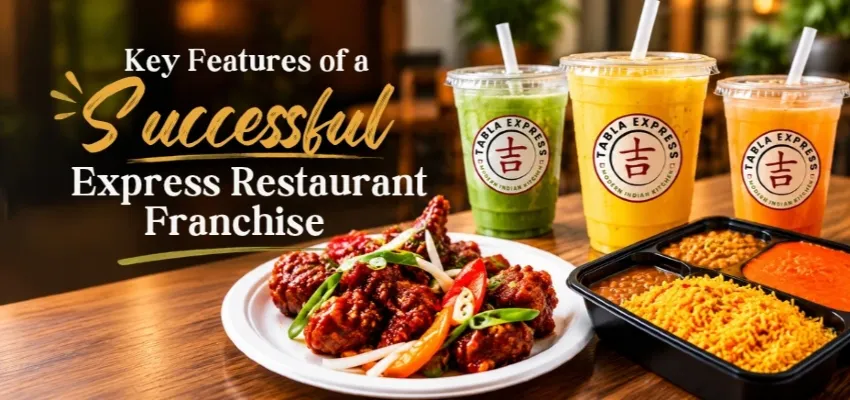
Express serves the top 20 best-selling Tabla menu items, freshly prepared in small batches: menu compression in practice.
Training
Two weeks of hands-on, one-to-one training before launch, plus onsite support for the opening. Tabla publishes two weeks for Fast Casual and three for Fine Dining, each covering operations, team setup and guest service.
Site Selection and Technology
Tabla lists site selection among its support areas and positions Express for malls, food courts, airports and other high-traffic locations. It describes modern point-of-sale, inventory management and reservations software as part of the technology provided.
Marketing and Ongoing Support
A grand opening campaign at launch, with the brand development fund supporting brand awareness and business development across all franchise outlets and local advertising funding hyper-local marketing. Tabla describes royalty funds as providing continued support, training and operational excellence, with ongoing performance analysis.
The Published Fee Schedule
Tabla publishes one schedule of ongoing fees, each on its own stated basis:
- Royalty: 6% of gross sales, weekly
- Brand development: 2% of gross revenue, weekly
- Local advertising: 2% of gross revenue, monthly
- Technology fee: $500 or $750 per month
Items 5 and 6 of the Franchise Disclosure Document confirm the initial fee, every recurring charge, the basis each is calculated on and who receives it. Item 7 covers the estimated initial investment.
Tabla does not publish revenue or profit figures for any format. Item 19 is where a franchisor discloses any financial performance representation, and making one is voluntary. Item 20 carries the franchisee contact list.
Frequently Asked Questions About an Express Restaurant Franchise
Frequently Asked Questions
Everything you need to know — quick answers to the questions we hear most.
Q: What Is an Express Restaurant?
Q: What Makes a Food Express Franchise Succeed?
Q: How Much of Limited-Service Traffic Is Off-Premises?
Q: Which Ordering Channel Has Grown Fastest?
Q: How Important Is Speed to Customers?
Q: Do I Need a Drive-Thru to Run an Express Format?
Q: Does a Loyalty Programme Influence Where People Order?
Q: Is Quick Service Still Growing Faster Than Full Service?
Q: What Does Tabla's Express Franchise Cost?
Q: How Do I Start a Franchise Conversation with Tabla?
Start Your Express Franchise Journey with Tabla
Choosing the right restaurant franchise format is an important step before making an investment. With restaurant operations dating back to 2008, Tabla offers three franchise models: Express, Fast Casual, and Fine Dining, each designed to meet different business preferences and investment capacities.
If you are considering an Express Restaurant Franchise, explore Tabla's investment requirements, streamlined menu, training, and operational support to understand whether this model aligns with your business goals. Submit a franchise inquiry to start a conversation with our team.

Vasu Kohli
Vasu is a food and hospitality writer passionate about showcasing Tabla Indian Restaurant's franchise journey and growth. Through insightful content, she highlights what makes Tabla a compelling franchise opportunity, covering its proven business model, scalable operations, authentic culinary systems, and successful expansion across multiple states. She also brings the brand's dining experience to life by sharing stories about Tabla's authentic Indian cuisine, signature dishes, warm hospitality, and memorable guest experiences, helping readers discover what makes every visit special.