
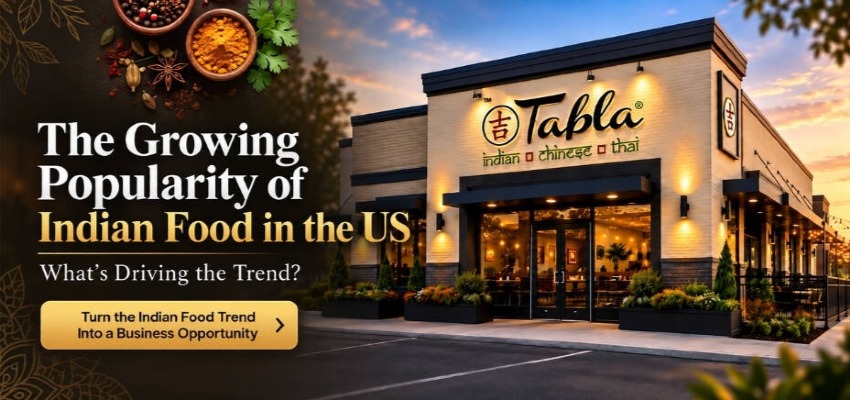
For decades, most Americans met Indian cuisine through a weekday lunch buffet and one order of chicken tikka masala. The popularity of Indian food in the US has since spread well past that buffet line, carried by delivery apps, grocery freezer aisles, and a younger generation of Indian American chefs.
This guide looks at what the data says is behind that shift and which dishes make the easiest starting point for a first-time diner. The second half turns to what the trend means for someone weighing an Indian restaurant franchise.
Quick Summary: The popularity of Indian food in the US tracks a growing Indian American community of about 4.8 million people, per Pew Research Center. Datassential counted 5,661 Indian restaurants and 2,222 Indian ghost kitchens in 2023. Butter chicken, samosas, and dal rank among the best Indian food to try first.
Why the Popularity of Indian Food Keeps Rising in the US
Several measurable changes have pushed Indian dishes onto more American tables in recent years. Each one has its own data trail, and together they explain why the cuisine has moved into everyday ordering habits.
A Larger Indian American Community
About 4.8 million Indian Americans lived in the US as of 2022, according to Pew Research Center's analysis of Census Bureau data. They make up 20% of the country's Asian American population, and roughly half live in four states: California, Texas, New Jersey, and New York.
Those population centers support clusters of Indian grocers and restaurants. Neighbors outside the community become regular customers, and the cuisine spreads outward from there.
More Restaurants and Delivery-Only Kitchens
Datassential's Firefly database counted 5,661 Indian restaurants in the US in early 2023, compared with 7,515 Thai restaurants. The gap narrows once delivery-only operations enter the count: Datassential found 2,222 ghost kitchens serving Indian food, against 355 for Thai.
Curries, dal, and biryani hold their heat and texture well in a takeout container. That helps explain why so much of the cuisine's recent growth has come through delivery apps rather than dining rooms.
Plant-Based and Spicy Eating Going Mainstream
Datassential points to two consumer shifts working in the cuisine's favor: a growing appetite for spicy food and for plant-based meals. Lentil dal, chickpea chana masala, and palak paneer, spinach cooked with fresh cheese, are vegetarian by default.
That gives a meat-free diner several full entrées on a typical Indian menu, a range many other cuisines can't match without substitutions.
A Cuisine Still Early in Its Growth Curve
Datassential places Indian cuisine in the "Adoption" stage of its Menu Adoption Cycle, one step behind Thai, which has reached "Proliferation." Its consumer data shows 30% of Americans love or like Indian food, against 42% for Thai.
The market projections point the same direction. Persistence Market Research expects the Indian segment of the US Asian food market to grow at a 6.1% CAGR through 2032, and IBISWorld estimated US Indian restaurant industry revenue at $4.9 billion in 2024.
Regional Indian Cuisines and How Their Flavors Differ
Indian restaurant menus in the US draw from several regional kitchens, each built on different staples, cooking fats, and spice blends. The table below compares five of the regional styles most often found on American menus.
| Region | Core Flavors and Techniques | Signature Dishes |
|---|---|---|
| North Indian (Punjab, Delhi, Kashmir) | Tandoor cooking, dairy-rich gravies, wheat breads, garam masala | Butter chicken, chole bhature, rogan josh, naan |
| South Indian (Tamil Nadu, Kerala, Karnataka, Andhra Pradesh) | Fermented rice and lentil batters, coconut, curry leaves, tamarind | Masala dosa, idli, sambar, Chettinad chicken |
| West Indian (Gujarat, Maharashtra, Goa) | Sweet and sour balance in Gujarati cooking, vinegar and chili in Goan dishes | Dhokla, pav bhaji, vindaloo |
| East Indian (West Bengal, Odisha) | Mustard oil, mustard seed paste, panch phoron five-spice blend, freshwater fish | Macher jhol, shorshe ilish, rosogolla |
The Best Indian Food to Try on a First Visit
The best Indian food to try first usually comes down to a handful of anchor dishes that appear on most Indian restaurant menus in the US. Each one below is a common entry point, with a short note on what arrives at the table.
Butter Chicken (Murgh Makhani)
Butter chicken is tandoor-cooked chicken simmered in a tomato gravy finished with butter and cream, a dish that comes from Delhi. Datassential notes that US diners mostly know chicken makhani by its English name, which has helped its reach.
Chicken Tikka Masala
Chicken tikka masala is marinated, grilled chicken in a spiced tomato and cream sauce, tangier and more tomato-forward than butter chicken. Its origin is disputed, though it is most often credited to a Glasgow restaurant in the 1970s.
Samosa
A samosa is a fried pastry filled with spiced potatoes and peas, usually served with mint and tamarind chutneys. It works as a low-risk starter because the filling is familiar and the heat is mild.
Dal
Dal is lentils simmered until soft and finished with a tadka, whole spices bloomed in hot ghee or oil. Yellow dal tadka and the slow-cooked black dal makhani are two widely served versions.
Biryani
Biryani is long-grain basmati rice layered with marinated meat or vegetables and whole spices, then cooked in a sealed pot. Hyderabadi and Lucknowi biryani are two of the best-known regional styles.
Masala Dosa
Masala dosa is a thin, crisp crepe made from fermented rice and lentil batter, wrapped around spiced potatoes and served with sambar and coconut chutney. It gives a first-time diner a direct introduction to South Indian cooking.
The Best Indian Food for Beginners, Ranked by Heat
Spice level is a frequent concern for first-time diners, and heat varies widely by restaurant and by region. The best Indian food for beginners sits at the mild end of the table below, and many restaurants adjust heat on request.
| Dish | Typical Heat | Why It Works for a First Order |
|---|---|---|
| Butter chicken | Mild | Creamy tomato gravy softens the spices |
| Chicken korma | Mild | Nut- or yogurt-based sauce with little chili |
| Samosa | Mild | Familiar potato filling, chutneys served on the side |
| Dal tadka | Mild | Soft lentils, with heat coming mostly from the tempering |
| Chicken tikka masala | Mild to medium | Tangy tomato sauce, a small step up in spice |
| Chicken biryani | Medium | Aromatic whole spices, heat varies by regional style |
| Vindaloo | Hot | Sharp vinegar and chili heat, better saved for a later visit |
Heat levels reflect typical preparations. A few ordering habits make a first visit easier:
- Order one mild curry and one dry dish, such as tandoori chicken, to compare textures.
- Pair curries with both rice and naan so the table can soak up the sauce.
- Share plates family-style, the way Indian meals are usually served.
- Read the menu descriptions closely, since dish names can be unfamiliar. Datassential found only 13% of US consumers know ras malai, a milk-based dessert, by name.
What Rising Demand Signals for Restaurant Operators
Put these data points side by side and a pattern appears. Americans already order Indian food in large numbers through delivery, yet the cuisine still trails Thai in restaurant count and consumer familiarity. That gap reads as a category where demand is established and storefront supply has room to catch up.
The dishes that bring beginners in are also the easiest to standardize. Butter chicken, dal, and biryani follow repeatable recipes and hold up in delivery containers. For an operator, the same menu that converts first-time guests can run consistently across multiple locations.
That pairing, measurable demand and a menu that can be systematized, is what turns a food trend into a franchise question.
Comparing Indian Restaurant Formats for Franchise Investment
The format an operator chooses shapes the guest experience, the footprint, and the capital required. This table compares the three formats most commonly used for an Indian restaurant.
| Format | Customer Experience | Best Fit |
|---|---|---|
| Fine Dining | Table service, full menu, longer visits built around dinners and celebrations | Operators with hospitality experience and a larger capital budget |
| Fast Casual | Counter ordering with food made to order, for dine-in and takeout | Owners who want counter service with a made-to-order menu |
| Express / QSR | Compact counter with a focused menu, built for speed and takeout | Owners targeting high-traffic sites, food halls, or smaller spaces |
How Tabla Franchises Indian Dining Across Three Formats
Tabla's franchise concept maps directly onto the three formats above. The details below come from Tabla's published franchise materials; financial performance information is available only through the Franchise Disclosure Document.
A Restaurant Brand Operating Since 2008
Tabla started in Orlando in 2008, founded by Nora and Anshu Jain, and serves Indian, Indo-Chinese, and Thai cuisine. The brand now operates locations across Florida, Illinois, Kentucky, Minnesota, Texas, and Massachusetts. Announced upcoming markets include Elgin in Illinois, Rutherford in New Jersey, and Shelby in North Carolina.
A Menu With Several Entry Points
Tabla's menu pairs Indian curries and biryanis with Indo-Chinese and Thai sections. A group with mixed spice tolerance or mixed familiarity with Indian food has more than one place to start.
Franchise Fees and Investment by Format
Tabla publishes its fees and total investment ranges by format:
- Fine Dining: $45,000 franchise fee; total investment of $326,331 to $631,211
- Fast Casual: $36,000 franchise fee; total investment of $187,201 to $405,682
- Express/QSR: $36,000 franchise fee; total investment of $187,201 to $405,682
- All formats: 6% royalty and 2% brand development fund contribution, both on gross sales
Training and Opening Support
Pre-opening training runs three weeks for Fine Dining and two weeks for Fast Casual and Express, with Express training delivered one-on-one. Franchisees also receive on-site support during opening week, site selection guidance, marketing support, and technology systems for order management.
Standardized Chef-Independent Kitchen Systems
Tabla's kitchens run on standardized recipes and prep procedures, so a franchisee does not need to hire an executive chef. For a cuisine where consistency in biryani, dal, and curry bases depends on process, that repeatability carries across every location.
What the Trend Means for Diners and Future Franchisees
For diners, growing demand means more regional dishes on local menus and more ways to order them. The best Indian food for beginners, butter chicken, samosas, and dal, is easier to find through delivery apps, where Datassential counted more than 2,000 Indian ghost kitchens.
For prospective franchisees, the same data points to a cuisine with established demand and fewer storefronts than comparable Asian cuisines. Choosing a format comes down to available capital, target site, and prior operating experience.
Performance and earnings information should come from a brand's Franchise Disclosure Document, which federal rules require a franchisor to provide at least 14 days before any agreement is signed.
Frequently Asked Questions About Indian Food in the US
Q: Why Is Indian Food Becoming More Popular in the Us?
A growing Indian American community of about 4.8 million people, more delivery-only kitchens, and rising interest in spicy and plant-based meals are the main drivers, according to Pew Research Center and Datassential data.
Q: How Many Indian Restaurants Are There in the Us?
Datassential counted 5,661 Indian restaurants in early 2023, plus 2,222 ghost kitchens serving Indian food.
Q: What Is the Best Indian Food for Beginners?
Butter chicken, samosas, dal tadka, and chicken korma are mild, familiar starting points for a first order.
Q: What Is the Best Indian Food to Try If I Don't Like Spicy Food?
Butter chicken and chicken korma are the safest picks, since both use creamy sauces with little chili heat.
Q: What Is the Difference Between Butter Chicken and Chicken Tikka Masala?
Butter chicken has a richer gravy finished with butter and cream, while chicken tikka masala is tangier and more tomato-forward.
Q: Is Indian Food Good for Vegetarians?
Yes, dishes like dal, chana masala, and palak paneer are vegetarian by default, so Indian menus typically offer several full meat-free entrées.
Q: Is Opening an Indian Restaurant a Good Business Opportunity?
Indian cuisine shows established demand, including a projected 6.1% CAGR for the Indian segment of the US Asian food market through 2032, though any investment decision should rest on a brand's Franchise Disclosure Document and independent advice.
Q: What Franchise Formats Does Tabla Offer?
Tabla franchises Fine Dining, Fast Casual, and Express/QSR formats so you can choose one that suits you the best.
Q: What Training Does a Tabla Franchisee Receive?
Training runs two to three weeks depending on format, followed by on-site support during opening week.
Q: How Do I Start a Franchise with Tabla?
Submit an inquiry through the franchise form at tablafranchise.com, which leads to a consultation with the franchise team, a visit to an existing location, and franchise documentation.
Take the Next Step
The popularity of Indian food in the US now shows up in delivery orders, grocery aisles, and restaurant counts, and the category still has room for more storefronts. To compare Tabla's three formats against your budget and target market, submit an inquiry at tablafranchise.com and the franchise team will follow up with next steps.

Vasu Kohli
Vasu is a food and hospitality writer passionate about showcasing Tabla Indian Restaurant's franchise journey and growth. Through insightful content, she highlights what makes Tabla a compelling franchise opportunity, covering its proven business model, scalable operations, authentic culinary systems, and successful expansion across multiple states. She also brings the brand's dining experience to life by sharing stories about Tabla's authentic Indian cuisine, signature dishes, warm hospitality, and memorable guest experiences, helping readers discover what makes every visit special.